Oklahoma Senate committee advances bill to prohibit manufacturing and sales of cultivated, lab-grown meat statewide
Measure clears first Senate hurdle after committee debate over markets, regulation, and consumer choice
A bill that would prohibit the manufacture, sale, and distribution of cultivated, cell-cultured meat products in Oklahoma advanced Feb. 9, 2026, after receiving approval from the Senate Agriculture and Wildlife Committee on a 9–3 vote. The proposal, Senate Bill 2121, would create a new state-law ban while carving out a narrow exemption for research conducted by government entities, higher-education institutions, and formally partnered organizations.
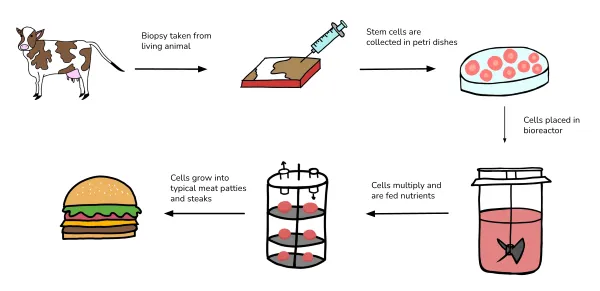
The bill defines “cultivated meat” as a meat or meat product produced from cultured animal tissue grown from in vitro animal cell cultures outside the animal from which the cells were derived. Under the measure, it would be unlawful for any person to manufacture, sell, hold or offer for sale, or distribute cultivated meat products in the state. A violation would be classified as a misdemeanor upon conviction.
The proposal also grants the Oklahoma State Department of Health authority to adopt rules to implement the ban and to apply enforcement measures. For licensed food sellers, the bill outlines potential administrative consequences: a license could be suspended or revoked if an owner or employee is convicted of violating the prohibition, under rules adopted by the Health Department.
Arguments centered on oversight, market access, and the cattle economy
During the committee hearing, lawmakers debated whether a statewide prohibition is an appropriate response to an emerging food technology and how the state should balance consumer choice against public-health and economic concerns. Supporters framed the measure as a safeguard for Oklahoma’s agricultural sector and as a pause on a new industry while policymakers evaluate standards and risks. Opponents raised concerns that a ban would limit consumer options and tilt the marketplace by restricting a product category rather than regulating it.
The discussion also included whether a time-limited moratorium might be preferable to an outright ban, and whether the Legislature should focus on disclosure and labeling rather than prohibitions. Supporters countered that the legislation is intended to set a clear statewide boundary until further information and regulatory certainty develop.
How the proposal fits alongside Oklahoma’s existing labeling framework
SB 2121 does more than establish a ban. The introduced text includes amendments to state law governing food advertising and definitions used for manufactured-protein products. Oklahoma previously enacted a “truth in food labeling” approach requiring certain cultivated- or manufactured-protein food products—including those derived from plant or insect proteins—to be clearly labeled as distinct from meat. SB 2121 would move beyond labeling by prohibiting cultivated meat products altogether, while leaving research activity in Oklahoma permissible under specified conditions.
Prohibits manufacturing, selling, distributing, or offering cultivated meat for sale in Oklahoma.
Classifies violations as a misdemeanor upon conviction.
Allows health regulators to set enforcement rules and authorizes license suspension or revocation for convicted sellers.
Exempts research by government entities, higher education, and formal partners.
With committee approval secured, SB 2121 next proceeds through the Senate legislative process, where it would need further action before it could be considered by the House and, ultimately, sent to the governor.